How to find an apartment in the Netherlands
Understand which rentals you can realistically get, what landlords may and may not ask for, and how to plan a search that works.
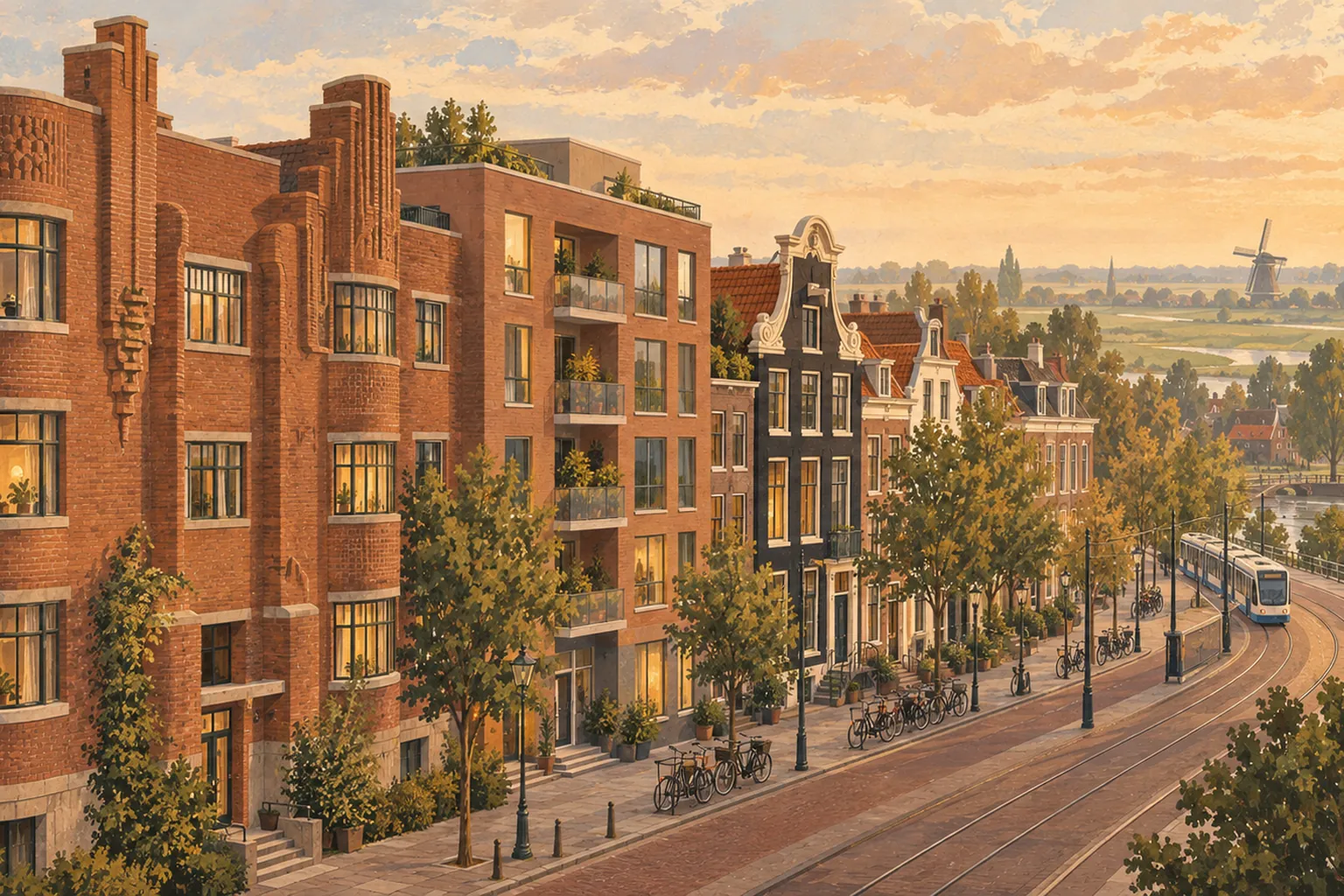
Finding an apartment in the Netherlands starts with knowing which part of the rental market you can realistically enter. Most newcomers rent privately, through estate agents and listing websites, so the practical work is preparing to reply quickly and checking each offer before you pay.
This guide covers the whole country. For local rules, permits and neighbourhoods, read the city guides for Amsterdam, Utrecht, Rotterdam and The Hague.
1. Know the three rental sectors
Dutch rental homes are placed in a sector by a points system (the WWS), which scores things such as floor area, energy label and facilities. The points set the maximum rent. Government.nl's step-by-step plan for tenants gives the 2026 limits used below.
Social housing (sociale huur)
Homes with up to 143 points and a starting rent of €932.93 a month or less in 2026. Most are owned by housing associations (woningcorporaties) and allocated through regional portals. For most allocations, the government's 2026 income limits are €51,537 a year for a single-person household and €56,910 for larger households (page in Dutch).
Realistic for: people who plan to stay long term and can wait. In the Rotterdam region, for example, housing association Woonstad explains that when you get a home usually depends on how long you have been registered (in Dutch). If you expect to stay, register early, but do not rely on it for your first home.
Mid-rent (middenhuur)
Since the Affordable Rent Act (Wet betaalbare huur) took effect on 1 July 2024, homes with 144 to 186 points have a maximum rent. In 2026 the top of the mid-rent band is €1,228.07 a month, according to Volkshuisvesting Nederland (in Dutch). The maximum applies whoever the landlord is, including private landlords and investors.
Realistic for: middle-income households, but check local rules. Amsterdam, for instance, requires a housing permit for homes up to 186 points or €1,228.07 basic rent, with its own income limits. Other municipalities set their own conditions.
Free sector (vrije sector)
Homes with 187 points or more. There is no maximum starting rent. Government.nl's rented housing overview says annual rent increases in this sector are capped until May 2029.
Realistic for: most people moving to the Netherlands for work who need a home soon. A self-contained home advertised above €1,228.07 a month should normally score 187 points or more. Compare advertised prices on our rent price pages before setting a budget.
If you think a home is priced above its points, the Huurcommissie's Rent Check estimates its points and maximum rent. For contracts from 1 July 2024, a tenant can ask the Huurcommissie to assess the starting rent within six months of the contract start if the home scores 186 points or fewer (Huurcommissie, in Dutch).
2. How the private rental market works
Private rentals reach you through three main routes. The same home can appear on several of them.
- Listing websites. Pararius, Funda, Kamernet, HousingAnywhere and others. Some are free to reply on and some charge tenants a subscription. Our overview of the best rental websites in the Netherlands explains what each one is for and what it costs to reply.
- Estate agents (makelaars). Agents often advertise on their own websites as well as on the large portals. You apply through the agent, who screens applicants for the landlord.
- Institutional landlords. Large owners let directly or through property managers. Vesteda lets houses and apartments across the country and says registration is free. Holland2Stay lets furnished homes in several cities. Bouwinvest says that from 1 January 2026 its homes are let through its partners MVGM and vb&t.
Under the Good Landlordship Act, a landlord who advertises a home must say how tenants will be selected, and must explain to unsuccessful candidates why someone else was chosen (government brochure, PDF). Read those criteria before replying: they usually cover income, household size and the start date.
3. Check the income requirement
Most private landlords ask for a minimum income, usually expressed as a multiple of the monthly rent. Many ask for a gross income of about three to four times the rent. The exact rule is the landlord's, so read each listing.
- Use the rent affordability calculator to turn your gross income into a maximum rent under a 3× or 4× rule.
- Use the budget explorer to see what that budget rents in each city.
- Read our guide to income requirements for renting for gross versus net, combined incomes and guarantors.
Mid-rent homes with a housing permit add a second test: your income must also be under the municipality's limit.
4. Registration, BSN and "registration allowed"
If you will live in the Netherlands for longer than four months, you must register in the Personal Records Database (BRP) with your municipality within five days of arriving, according to Government.nl. NetherlandsWorldwide explains that you receive a citizen service number (BSN) when you register, if you do not already have one. Book the appointment early; municipalities often require one.
This is why listings say "registration allowed" or "registration possible". You need a home you can register at to get a BSN through your municipality, and you need the BSN for contact with the government, such as for tax and healthcare. If a landlord says you cannot register, treat it as a warning sign. Tenant support organisation !WOON says a refusal may indicate illegal subletting or tax evasion.
If you stay for four months or less, you can register as a non-resident in the RNI instead and receive a BSN that way (NetherlandsWorldwide).
5. Temporary or permanent contract?
The Permanent Rental Contracts Act (Wet vaste huurcontracten) took effect on 1 July 2024. Since then, new rental contracts are normally for an indefinite period. The Dutch government's temporary contract rules list the exceptions, such as students renting temporarily in another municipality for their studies, and people who need a home temporarily because of work or renovation of their own home (in Dutch). A temporary contract signed after that date lasts at most two years.
Contracts signed before 1 July 2024 keep their original terms. If one is renewed with the same tenant, it becomes permanent.
Rules may change again. In July 2026 the government opened a consultation on a bill that would limit short-stay rental to 30 days and allow temporary contracts for students and labour migrants (in Dutch). It is a proposal, not law.
6. Deposit limits and agency fees
The Good Landlordship Act (Wet goed verhuurderschap) applies to tenancy agreements from 1 July 2023. The government's brochure for tenants sets out the main rules:
- Deposit: at most two months' basic rent (kale huur, the rent without service costs).
- Agency fees: if the landlord uses a rental agency, the landlord pays its fees. The agency cannot charge you as well.
- Written contract: the tenancy agreement must be in writing.
- Service costs: you pay only the actual costs and receive an overview every year.
Government.nl's step-by-step plan adds that a deposit is normally returned within 14 days of the tenancy ending, or within 30 days if the landlord deducts costs. If you hired an agent yourself to search for you, that agent may charge you. !WOON explains how to reclaim unfair agency fees. Every municipality also has a reporting office for complaints under the Act.
7. Check for scams before you pay
Scammers copy real listings or invent homes with low rents in popular areas. The Fraudehelpdesk's rental fraud advice (in Dutch) and !WOON's scam checklist recommend checks like these:
- View the home yourself, or send someone you trust. Do not deal with a landlord who says a viewing is impossible.
- Check who owns it. !WOON points to the Kadaster property register, which charges a small fee. If the landlord is not the owner, ask for written permission to let.
- Check the agency in the Chamber of Commerce (KvK) register and on its own website. Contact it through the details you find there, not the details in the ad.
- Pay by bank transfer, and be wary of requests to pay abroad or through money-transfer services.
- Ask about registration. A landlord who refuses registration is a warning sign.
- Keep records: screenshots of the ad, emails and receipts.
Share ID with care. Our document checklist explains how to cover your BSN and watermark a copy.
8. A realistic search plan
There is no reliable national average for how long a search takes. Timing depends on your city, budget, household and income, and on how many other people apply. Plan for uncertainty:
- Before you arrive: arrange temporary accommodation that covers your first weeks, or longer if your budget is tight. Check whether it allows registration if you will need a BSN from it.
- Set your budget: work out your maximum rent from your gross income, then compare it with median advertised rents in the cities you are considering.
- Choose where you would live: include nearby towns you could commute from. Map what you can reach with the commute finder, then check real trips in the 9292 journey planner.
- Prepare your file: gather payslips, an employer's statement and ID, and write a short introduction. Use our document checklist and rental application letter templates.
- Set up alerts on the websites you use, or use a service such as Hesra's rental alerts, which emails you new listings for a city or town and an optional maximum rent.
- Reply quickly and follow each listing's process. Keep a simple tracker of what you sent and when.
- Register for social housing in your region if you expect to stay for years. Check the portal's fees and conditions; registration time only starts counting once you sign up.
Common questions
Can I rent an apartment in the Netherlands without a BSN?
Often, yes. You usually receive a BSN after you register at your address, so many people sign a rental contract before they have one. Some landlords or agents may ask for it; ask why they need it. Choose a home where registration is allowed, so that you can register and receive your BSN.
How long does it take to find an apartment in the Netherlands?
There is no reliable typical timeframe. It depends on the city, your budget, your income compared with the landlord's requirement, and competition for each home. Start with temporary accommodation and a prepared application file, so you can reply as soon as a suitable listing appears.
Is it hard to find housing in the Netherlands?
It can be. The government's coalition agreement describes a housing shortage affecting both buyers and renters and makes tackling it its top priority. Your chances improve with a realistic budget, a flexible search area and a complete application.
Can expats get social housing?
There is no separate route for expats. You register on the regional portal and must meet the income limit and other conditions. In many regions, allocation depends largely on how long you have been registered, so it rarely works for a first home. Check your region's portal for its rules.
Is the 3x income rule a law?
There is no single national income rule for private rentals. The multiple is the landlord's selection criterion, and the landlord must state how it selects tenants when advertising. Mid-rent homes that need a housing permit also have municipal income limits.
How much is rent in the Netherlands?
It varies widely by city and home type. See Hesra's rent prices for median advertised rents in the cities we track, then set your budget with the rent affordability calculator.
Ready to find your next home?
Choose a city, add your maximum monthly rent and get matching rental alerts by email.